I get this question more than I expect; people want to know the common eating disorder signs.
To be officially diagnosed with an eating disorder, you must see your primary care doctor or a licensed mental health professional.
However, below I’m going to share common signs that you might struggle with disordered eating.
15 Commons Eating Disorder Signs
1) you eat the same thing everyday; there’s little variety in your food choices
2) you have rules around what time you can or cannot eat
3) you lie or are secretive about eating and exercise behaviors
4) you find yourself trying to eat as little as possible
5) you think about FOOD a lot during the day, even when not eating
6) you feel out of control around food, like something else takes over
7) you weigh yourself daily
8) you panic or feel anxious when healthy food isn’t available for you to eat
9) you get upset if someone interrupts a workout or you can’t exercise
10) you measure or weigh your food
11) you obsess over a menu before you go to the restaurant
12) you feel extreme guilt or shame after eating
13) you’re obsessed with ingredients in your food
14) you say “no” to social outings where food is involved
15) you “forget to eat” or are too busy to eat
You do not have to have ALL of these to battle disordered eating. Also, just because you do experience some of these does not mean you have an eating disorder.
Get help. Eating disorders are a mental illness and if you identify with these common eating disorder signs, it is best to take action right away.
Tell someone or seek a professional to help you. The best place to start is with a therapist who specializes in eating disorders. Psychology Today has a great list of therapists where you can see their speciality and their contact info. Also, visit the NEDA website for even more information.
In 2016, I hosted the first Austin Eating Disorder Support Group.
And in 2008, I went to my first eating disorder support group in Boston.
I sat in my parked car for 20 minutes negotiating with myself. Do I go? No. I should go home. This is dumb. I don’t need help. What if someone sees me?
I can hardly talk about my eating disorder to ONE person let alone multiple people in an eating disorder support group.
Against the eating disorder’s will, I found myself at the front door. I was doing this. And I continued to go for weeks.
Until I realized that my eating disorder actually got worse. During group I found myself comparing and trying to ‘win’ at having an eating disorder. I didn’t realize at the time, but I got ideas on how to strengthen the eating disorder. There were no rules and little focus on getting better.
I never went to a ED group again. Until… I led my own in Austin.
A year into coaching, I saw a need to start an Austin eating disorder support group.
I re-read Catherine Steiner Adair’s book Full Of Ourselves to get a sense of what’s important for running a group. I went to a weekend long training seminar on leading groups in Austin as well.
5 Steps – Start An Eating Disorder Support Group In Your City
If you want to start a support group where you live, steal my approach below! It’s FIVE steps.
1) Have a mission for the eating disorder group
My mission statement: “in this group, we build a new set of beliefs about ourselves, create a customized plan for recovery and take action. The outcome? Growth and progress in recovery.”
Ask yourself why your mission is important and what it will achieve.
2) Find a focus for your support group
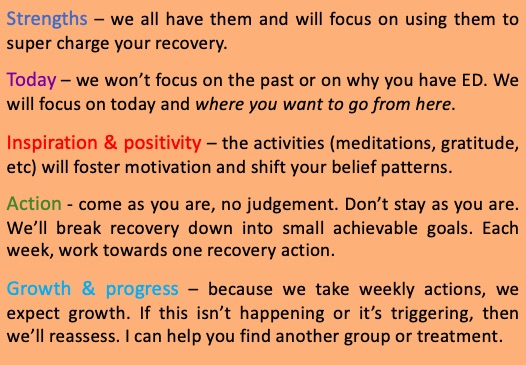
My Austin Eating disorder support group is very different from others. In fact I don’t even call it a support group! I call it a Healing & Action Recovery Group.
We focus more on the present and future than in the past. It’s not for everyone and that’s okay. I’ve seen this approach work in my coaching which is why it felt important to offer it in a group. My key focus areas are as follows:
Focus for Austin Eating Disorder Support Group
3) Have rules and guidelines
Make your own or free to steal mine! These are the guidelines I send to all members:
NUMBERS: no numbers or specific behaviors of any kind. Refrain from mentioning specific foods.
JUDGING: we don’t do it. Not to ourselves or others.
CARE: get to know one another, NOT each others’ eating disorders
LISTEN: respect the talker. If a story is dominating the time, I will interrupt.
OPENMINDED: we all come from different experiences and backgrounds. Try to learn and be open to others’ points of view
4) Get people to come to the support group
When I first started this group, I posted about it on meetup. I created a closed Facebook group and added my mom as the only member 🙂 Now it’s about 40 members. Remember that it takes time. Be patient with yourself.
I also recommend putting it on Nextdoor and your local paper. I shared with friends that I was starting an Austin Eating Disorder Support Group and asked if they knew anyone interested.
5) Determine logistics for your eating disorder support group
So many local spaces are willing to give you space for free. Some is paid for. I called libraries, churches and wellness spaces to ask about availability of a weekly room for the support group. Finally, decide if you are charging for the group, if it will be free or donation based.
A word to the wise: this does take up a fair amount of time. Preparing, sending email reminders, coordinating the space to host it in, creating online groups, etc. I definitely under estimated how much time it would take, so factor that in when deciding to charge.
Final words: we need more eating disorder support groups! If there’s not one where you live, please start one. At least one other person struggling needs you to! Also, find someone to help you. Call an ED therapist in your area, ask her or him to partner with you and lead it!
Feel free to email me with any questions – I’m happy to ‘support’ you. Get it, support?
Do you want to stay in touch and get actionable recovery tips? Me too!
Make sure you’re on my 2-actions Tuesday Email list! Each Tuesday you’ll get 2 actions you can take right away to get you closer to freedom. Enter your info below – promise I won’t spam ya 🙂